

The 1944 Nisei draft at Heart Mountain, Wyoming: Its relationship to the historical representation of the World War II Japanese American evacuation
by Arthur A. HansenProfessor of History and Director of the Oral History Program
California State University, Fullerton
Part 2
On May I, Heart Mountain's director, Guy Robertson, informed WRA Director
Dillon Myer by post that "Sergeant Kuroki was dined and danced and spoke before many
different groups, including members of the so-called Fair Play Committee," yet felt
compelled to add that on Kuroki's departure day, six more Nisei refused their
preinduction examinations. The weekly reports by the camp's community analyst,
Asael Hansen, are still more revealing.
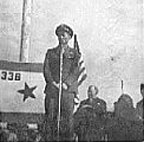 They indicate that the shy five feet, nine inch, 145
-pound airman's reception at Heart Mountain was a decidedly mixed one. Whereas
3,000 camp residents greeted him, the crowd at a scheduled mid-week address was
much smaller than anticipated and hardly anybody gathered for his sendoff. Then, too, while Kuroki's speeches were applauded and he was swarmed over by the
camp's adoring children and teenagers, their Japanese alien parents were offended by
his completely American ways and point of view on the war (such as his emphatic
prediction that "we" will soon bomb Japan). His encounters with Nisei draft resisters,
moreover, did not proceed smoothly. Four of them allegedly had a session with him
punctuated by this exchange: "What would you do if you were us?" "I'd volunteer for
induction." 'So you think it is all right for us to be evacuated and locked up here." On
another occasion, following a "quite heated" session between Kuroki and the
FPC membership, "a few of the men expressed a strong desire to beat him up."
They indicate that the shy five feet, nine inch, 145
-pound airman's reception at Heart Mountain was a decidedly mixed one. Whereas
3,000 camp residents greeted him, the crowd at a scheduled mid-week address was
much smaller than anticipated and hardly anybody gathered for his sendoff. Then, too, while Kuroki's speeches were applauded and he was swarmed over by the
camp's adoring children and teenagers, their Japanese alien parents were offended by
his completely American ways and point of view on the war (such as his emphatic
prediction that "we" will soon bomb Japan). His encounters with Nisei draft resisters,
moreover, did not proceed smoothly. Four of them allegedly had a session with him
punctuated by this exchange: "What would you do if you were us?" "I'd volunteer for
induction." 'So you think it is all right for us to be evacuated and locked up here." On
another occasion, following a "quite heated" session between Kuroki and the
FPC membership, "a few of the men expressed a strong desire to beat him up."
When Kuroki granted the aforementioned interview to the Wyoming Tribune in the wake of the November trial of the FPC leaders and James Omura, he told the reporter about the two sessions that Asael Hansen had documented a half year earlier. On the first occasion the resisters had rationalized their not showing for their draft physicals by quoting laws and the Constitution, though he could tell that "they didn't really understand what they were talking about but had been influenced by others." Convinced that the FPC was the influencing agent, he met with that organization and registered his strong disapproval of their actions. However, they persisted along the same course, culminating in the trial of their "key leaders" that had brought him to Cheyenne as a government witness against them.
Before Heart Mountain's November 1945 closure, 85 men were imprisoned for draft law violations, while for all ten WRA camps the total was 315. Averaging twenty-five years in age, the resisters typically served two years in federal prisons before President Harry Truman issued them a blanket postwar pardon. As for the FPC leaders, their verdict and sentencing was overturned on appeal after eighteen months of imprisonment. Not all WRA camp draft resisters were given the same treatment, for it depended on what judge heard their case. For example, Judge Louis Goodman dismissed the indictments against seven Tule Lake, California, draft resisters. "It is shocking to the conscience," he declared, "that an American citizen be confined on the ground of disloyalty and then, while so under duress and restraint, be compelled to served in the armed forces or be prosecuted for not yielding to such compulsion."
In spite of substantial draft resistance, the great majority of eligible Nisei men in the WRA camps complied with their orders. Even at Heart Mountain, 700 men reported for their selective service physicals; of these, 385 were inducted, of whom eleven were killed and fifty-two wounded in battle. Totally some 13,500 Nisei men from the ten camps entered the U.S. Army. More than 75 percent of them-or put another way, more than 50 percent of all eligible Nisei males-saw army service in the 442nd Regimental Combat Team during its 225 days of heavy combat in Italy and France in 1944-45. This represented the highest percentage of eligible males of any racial or ethnic group assigned to a World War II combat unit, and this situation resulted in more than 700 deaths and 9,486 casualties. When President Truman received the 442nd on the White House lawn on 15 July 1946, he told them, "You fought not only the enemy but you fought prejudice-and you have won.
Ben Kuroki, whose fame was overshadowed by the collective exploits of the "Go For Broke" 442nd, nonetheless stayed in the limelight for several years after his sojourn at Heart Mountain. While there he had announced his intention to fight in Asia-and before long he did. In 1945, he overcame a War Department regulation to become the first and only Nisei to serve in active combat with the Army Air Force in the Pacific theater, participating as a turret gunner on a B-29 in twenty-eight bombing missions over Tokyo and other Japanese cities. When he returned to the United States in early 1946, he was booked into the palatial Waldorf Astoria Hotel and asked to take part with celebrated generals and political leaders in a New York Herald Tribune forum on the war, and his remarks were then published in the Reader's Digest ("The War Isn't Over at Home"). Kuroki also was the subject of a 1946 biography entitled Boy From Nebraska. After traveling around the country on a JACL-endorsed speaking tour, Kuroki married, attended college, and became, in his home state, the first Japanese American editor of a general newspaper. Later he won awards for journalistic excellence when editing a suburban Michigan newspaper before continuing (and ending) his career in southern California. Although not a public figure for most of the postwar years, Kuroki was the invited keynote speaker and honored guest at the December 6, 1991, opening of the Museum of Nebraska's exhibit on Nebraska and World War II. The very next day, the New York Times, in its lead editorial commemorating the fiftieth anniversary of Pearl Harbor, acclaimed Ben Kuroki as an "authentic hero" and linked his wartime accomplishments with those of the legendary 442nd.
For resisters like Frank Emi and their supporter James Omura there was no public applause, leastwise not until recently. The JACL's wartime position that the sole way for Nisei to prove their loyalty was through military service, coupled with the extraordinary postwar publicity given the 442nd and the concurrent image construction of Japanese Americans as a model minority, made these men anonymous in mainstream America and social outcasts among their coethnics. Insofar as draft resistance was heard of in the Japanese American community, it was in derogatory terms: "draft dodgers," "pro-Japan," "hot heads," "trouble-makers," and "traitors." Omura's situation was still worse. His "crime" of defending the FPC's position was compounded by his opposition to the JACL's leadership and public policy. Branded a pariah, he was harassed by members of his own community to the point where his employment opportunities dried up and his marriage ended in divorce. Remaining in Denver, he switched from journalism to landscape gardening, remarried, raised a family, and turned his back on other Japanese Americans and their concerns.
In the 1970s two University of Wyoming-based professional historians (Roger Daniels and Douglas Nelson) published books based strictly on written public records that dramatized the draft resistance movement at Heart Mountain and treated sympathetically the roles played by the FPC membership and Omura. But it was not until the next decade and the climax of the movement for Japanese American redress and reparations, according to Frank Emi, that their reputation as "demented ogres" was recast within (and even beyond) their community. After Congress established the Commission on Wartime Relocation and Internment of Civilians (CWRIC) in 1980, that body held hearings in six major U.S. cities during 1981-82 to investigate matters surrounding the wartime camps and to recommend appropriate remedies. At these hearings, resisters told their stories. In New York, for example, FPC member Jack Tono testified first that the JACL had abandoned the resisters during the war and made their lives miserable thereafter, and then rebuked Ben Kuroki, "our great war hero," for having labeled Frank Emi and the other FPC leaders "fascists" at their 1944 trial.
At CWRIC's Seattle hearing, redress activists (most notably, the renowned Chinese American playwright Frank Chin), were surprised to discover James Omura (who they believed dead) not only in attendance but testifying and apparently anxious both to enter the redress fray and to refurbish his and the FPC's reputation. By the time CWRIC had issued its report, Personal Justice Denied, in early 1983, Chin and his Japanese American cohorts had begun exhuming the resisters' buried past by taping oral history interviews with them and by systematically researching pertinent documents both in their personal collections and at institutional archives. Moreover, this same group of activists were primarily responsible for the participation of Omura, Emi, and numerous other resisters in academic symposia and community forums that spotlighted their wartime experiences.
Whereas CWRIC judged that the Japanese American evacuation was unjustified (caused not by military necessity, but by race prejudice, war hysteria, and a failure of political leadership) and recommended a formal apology by Congress to Japanese Americans along with $20,000 payments to each camp survivor), Chin and his widening band of allies were anxious to go beyond the commission's investigation and explore the machinations of the JACL leadership vis-a-vis Omura and the resisters. This task they began in earnest once President Ronald Reagan signed the Civil Rights Act of 1988, which enacted into law the CWRIC recommendations.
In the interval between 1988 and the present, the draft resisters and James Omura have secured their place in the sun in Japanese American and United States history. Although there continues to be opposition to this historical revisionism, particularly from "old guard" JACL leaders and reactionary patriots, whether or not of Japanese ancestry, the trend is unmistakable. Before his death in 1994 James Omura had been deluged with community, national, and international honors, and proclaimed an American hero in the tradition of Thomas Paine, Henry David Thoreau, Martin Luther King, and Caesar Chavez. Additionally, Frank Emi (the sole surviving FPC leader) and the resisters from Heart Mountain and the other WRA camps have been memorialized for their wartime role through a profusion of academic and commercial publications, documentary films, and imaginary literature. Their act of civil disobedience, twenty years before the 1960s civil rights movement, is now recognized as a historic benchmark in the U.S. civil rights chronology. Instead of invidious distinctions being made, as before, between the wartime behavior of the members of the 442nd Regimental Combat Team and the Heart Mountain Fair Play Committee. they are now styled as being different yet complementary species of praiseworthy Americanism.
Implementing the Lesson
Prior to teaching this unit, have students read the section in their U.S. history survey textbook devoted to the Japanese American Evacuation. If at all possible, assign Roger Daniels's brief but comprehensive 1993 study, Prisoners Without Trial: Japanese Americans in World War II, as collateral reading. It would also be useful to show one or more relevant documentary films. Stephen Okazaki's Years of Waiting, which is set largely at the Heart Mountain camp, is particularly effective because it deals with the plight of an interned Caucasian woman artist married to a Nisei, and hence speaks to Asian American and non-Asian American students alike. Another good documentary film to use is Rae Tajiri's History and Memory, since it communicates how memory preserves the wartime experience of Japanese Americans and can be used to supplement and challenge the historical representation of it in mainstream cultural constructions. A third documentary, Robert Nakamura's Something Strong Within, is good to use because its footage on camp life at Heart Mountain includes Ben Kuroki's 1944 visit there. First, pass out to students copies of the above "Historical Narrative." Then, after they have read this narrative, divide the class into small groups and have them discuss it briefly in general terms. Next, distribute the six handouts to the students and have them review their contents. Finally, as a class, discuss the questions on each of the handouts in sequential order.
Bibliography
Anderson, Jeffrey W. "Military Heroism: An Occupational [Operational] Definition." Armed Forces and Society 12 (Summer 1986): 591-606.
Appleby, Joyce, Lynn Hunt, and Margaret Jacob. Telling the Truth About History. New York: W.W. Norton, 1994.
Bodnar, John. Remaking America: Public Memory, Commemoration, and Patriotism in the Twentieth Century. Princeton: Princeton University Press, 1992.
Chan, Sucheng. Asian Americans: An Interpretive History. Boston: Twayne Publishers, 1991.
Chin, Frank. 'Come All Ye Asian American Writers of the Real and the Fake." In Jeffery Paul Chan et al, eds., The Big Aiiieeeee! An Anthology of Chinese American and Japanese American Literature. New York: Meridian, 1991.
Daniels, Roger. Concentration Camps USA: Japanese Americans and World War II. New York: Holt, Rinehart and Winston, 1971.
----------, Prisoners Without Trial: Japanese Americans in World War IL New York: Hill and Wang, 1993.
----------, Sandra C. Taylor, and Harry H. L. Kitano, eds. Japanese Americans: From Relocation to Redress. Salt Lake City: University of Utah Press, 1986.
Drinnon, Richard Keeper of Concentration Camps: Dillon S. Myer and American Racism. Berkeley: University of California Press, 1987.
Ehrlich, Gretel. Heart Mountain [novel]. New York: Viking, 1988.
Espiritu, Yen Le. Asian American Panethnicity: Bridging Institutions and Identities. Philadelphia: Temple University Press, 1992.
Hansen, Arthur A. Japanese American World War H Evacuation Oral History Project: Part IV: Resisters. Munich: K.G. Saur, 1995.
----------, "Oral History and the Japanese American Evacuation." Journal of American History 81 (September 1995): 625-39.
----------, "A Riot of Voices: Racial and Ethnic Variables in Interactive Oral History Interviewing." In Eva M. McMahan and Kim Lacy Rogers, eds., Interactive Oral History Interviewing. Hillsdale, NJ.: Lawrence Erlbaum, 1994.
Hosokawa, Bill. JACL in Quest of Justice: The History of the Japanese American Citizens League. New York: William Morrow, 1982.
----------, Nisei: The Quiet Americans. New York, William Morrow, 1969.
Ishigo, Estelle [Peck]. Lone Heart Mountain. Las Angeles: Hollywood Chapter of the Japanese American Citizens League, 1972.
Larson, T. A. Wyoming's War Years, 1941-1945. Laramie: University of Wyoming Press, 1954.
Lears, T. J. Jackson. 'The Concept of Cultural Hegemony: Problems and Possibilities." American Historical Review 90 (June 1985): 567-93.
Lee, Joann Faung Jean. Asian Americans: Oral Histories of First to Fourth Generation Americans from China, the Philippines, Japan, India, the Pacific Islands, Vietnam and Cambodia. New York: The New Press, 1991.
Mackey, Mike. "Heart Mountain Relocation Center: Both Sides of the Fence." M.A. Thesis, University of Wyoming, 1994.
Martin, Ralph G. Boy From Nebraska: The Story of Ben Kuroki. New York: Harper & Brothers, 1946.
Nelson, Douglas W. Heart Mountain: The History of An American Concentration Camp. Madison: The State Historical Society of Wisconsin, 1976.
Niiya, Brian, ed. Japanese American History: An A-to-Z Reference from 1868 to the Present. New York: Facts on File, 1993.
Nomura, Gail, et al., eds. Frontiers of Asian American Studies: Writing, Research, and Commentary. Pullman: Washington State University Press, 1989.
Norkunas, Martha. The Politics of Public Memory: Tourism, History, and Ethnicity in Monterey, California. Albany: SUNY Press, 1993.
Novick, Peter. That Noble Dream: The "Objectivity Question" and the American Historical Profession. Cambridge: Cambridge University Press, 1988.
Okihiro, Gary Y. Margins and Mainstream: Asians in American History and Culture. Seattle: University of Washington Press, 1994.
Stanford, Michael. A Companion to the Study of History. Cambridge: Blackwell, 1994.
Takaki, Ronald T. Strangers from a Different Shore: A History of Asian Americans. Boston: Little, Brown, 1989.
Takezawa, Yasuko I. Breaking the Silence: Redress and Japanese American Ethnicity. Ithaca: Cornell University Press, 1995.
Taplin, Ian M. "Why We Need Heroes to be Heroic." Journal of Popular Culture 22 (Fall 1988): 133-42.
Tateishi, John. And Justice For All: An Oral History of the Japanese American Detention Camps. New York: Random House, 1984.
Thelen, David, ed. Memory and American History. Bloomington: Indiana University Press, 1990.
Weglyn, Michi [Nishiura]. Years of Infamy: The Untold Story of America's Concentration Camps. New York: William Morrow, 1976.
Wilson, Robert A. and Bill Hosokawa. East to America: A History of the Japanese in the United States. New York: William Morrow, 1980.
Arthur A. Hansen is professor of history and director of the Oral History Program and its Japanese American Project at California State University, Fullerton. A specialist on the World War Il eviction and detention experience of Americans of Japanese ancestry, his most recent publication is "Oral History and the Japanese American Evacuation," Journal of American History (September 1995).
Reprinted from the Organization of American Historians Magazine of History, Summer 1996.
Back to: Part 1 of this study guide
Next: Related links
HOME | DOCUMENTS | STUDY CENTER | NEWS | LINKS | ABOUT US | E-MAIL
Updated: February 2, 1999