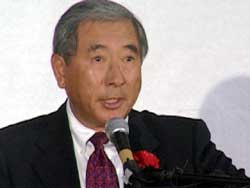
Statement by Floyd Mori, JACL National
President
May 11, 2002
delivered at the JACL Resisters Ceremony
Japanese Cultural & Community Center of Northern California
| Most of you know that I
was born and raised on a farm near Salt Lake City, Utah. I was a
toddler when the war began and I have only faint glimpses of memory of
the beginning of the war. I do remember clearly that relatives from
California came to live with us and near us during that time, and I
also remember their talk of "camp." I had no idea of what camp was, so
I did not pay much attention.
I do remember clearly the days when two of my older brothers left home and went into the Army. My oldest brother, who was the model son, never came back alive. I do remember the anguish of my family, particularly my mother, when the casket was brought home. Although I did not have the experience of camp, my family did experience the sorrows of war. |
|

My wife was also a young child during evacuation and traveled to Utah from
L.A. with her mother, father and brother to live with relatives. Her
father lost everything.
My youth was a time that I was introduced to JACL through my older
siblings. In recent months, I have often mentioned the various stages that
I feel JACL has experienced over the years. I have said that the postwar
years were a time when the JACL provided a major social function for our
communities. The sports like baseball, basketball and bowling, and dances,
and picnics were important in bringing our disrupted lives back together.
My older brothers and sisters all participated in these social activities,
and I, as a child, looked forward to the day when I would grow up and be
able to participate in the fun. During this stage of JACL, our focus did
not include a lot of civil rights issues.
During the era of protest, we focused on redress as our protest. We spent
a decade and a half mobilizing our chapters into political action
committees. We were dedicated and successful in our efforts and many of
you here were part of that protest movement. During this stage of JACL,
the social function was neglected and we have lost many of the programs
that brought us together socially after the war.
So what of the war years? What did JACL do during that time?
It was a time of great stress and uncertainty. For decades prior to the
war, the nation had been engaged in some very strong anti-Japanese
sentiment that had a major impact on our feelings as citizens and as human
beings. There was a vast empty feeling of fear as the war escalated and
camp became a reality for most who lived on the West Coast. There were
many conflicting feelings,
thoughts and ideas that flowed through our minds and hearts at this time.
Many were torn between the ideals of patriotism and justice. Unfortunate
incidents that occurred within the Japanese American community were
fraught with misinformation and to some, panic. We can look back by
listening to the stories of those who were there, but I think it is hard
for us who were not directly involved to actually feel what they felt nor
can we fully understand why they did what they did.
However, I think we can understand a little about the deep sense of
obligation that was felt by family members at this time. We did not want
to shame our family name and we wanted to do the right thing. Our
government, however, had placed our people in a no win situation.
Japanese Americans had experienced racial bigotry, and the fear of
reprisal was always in our minds.
So the focus of JACL during this stage of our past was patriotism. The
need to show a patriotic front became the activity that engulfed the
actions of JACL and many of its leaders.
Like in other stages of our organization when we emphasize only one aspect
of our mission, other aspects may be neglected. At that time, we did not
recognize and we neglected to respect the right of protest and civil
disobedience expressed by some who were in camps. These people felt deeply
that the injustice of incarceration needed to be rectified before they
could in good conscience answer the call to patriotism. This neglect has
caused years of mental and social anguish to those who felt strongly that
a correction of injustice was essential before they could express
patriotism toward the government that held them and their families
captive. In fact, their resistance was a means to emphasize the importance
of the Constitution under which the laws of the country were designed to
protect their individual rights.
Although we may never fully right the wrongs of the past nor may we fully
understand the emotional reasons for their occurrence, the national
council in our last convention in Monterey, recognized this neglect and it
was their vote that established today's event.
Today's ceremony is a clear recognition that JACL neglected to support the
resisters of conscience in their protest against injustice. In passing
this resolution at our last national convention, JACL offers a sincere
apology for the painful experiences and memories caused by this neglect. I
know that words cannot sufficiently restore that which was lost nor erase
the suffering that has occurred. But it is my hope that we can all share
in a sense of pride and honor for having been here today. May all of us
remember these events as a lesson that will improve our understanding and
increase our resolve to forgive and move to the next stages in our lives.
Now I know that there are those who have expressed major concern that JACL
would take the actions we have just taken. I challenge their assumption
that all resisters were cowards, troublemakers and hooligans. We recognize
those who were guided by the moral dictates of their conscience to protest
injustice. We do not condone any of the physical and mental harassment
that was perpetrated by some who called themselves resisters nor does
today's ceremony apply to them.
For those who served in the Armed Forces, we are proud of the legacy that
they left us. We honor them today as we have in many local and national
events in the past. Their service and valor, in large measure, are
responsible for the positive image that we in the Japanese American
community are blessed with today.
Let us today resolve to recognize that we must have a change in heart. Let
me paraphrase the thoughts of a modern Zen author, Les Kaye, who
admonishes us to see each other through new eyes. Our emotional priorities
should be reoriented from self to others. This is when fighting stops and
compassion awakens.
May we as individuals and as an organization strive to develop
understanding and its accompanying virtue of compassion. The terrorists of
today cannot find it within themselves to express compassion in any form.
The legacy of wrongs in the past have festered into the horrible blisters
of terrorism that we witness today.
May we learn from their folly in reasoning. Let us leave any wrongs that
have occurred in the past where they belong and from where we can learn.
Then let us bring in the future looking through a more selfless set of
eyes that seek
for understanding and a heart that has the capacity for expressing
compassion to our fellow men and women.
JACL is grateful for your attendance today. We thank the committee that
planned and worked hard to execute today's ceremony.
May all of us here today be blessed to be a catalyst that will bring peace
of mind and mutual respect to all who have suffered the pains of war and
injustice. Thank you.
Return to the News index of other related articles.
HOME | DOCUMENTS | STUDY CENTER | NEWS | LINKS | ABOUT US | E-MAIL
Updated: March 16, 2003