Statement by Frank Emi
Heart Mountain Fair Play Committee leader
May 11, 2002
delivered at the JACL Resisters Ceremony
Japanese Cultural & Community Center of Northern California
| The controversial issue of an apology by the JACL to the resisters of
conscience has been around since the 1980s and after weathering some
opposition from various quarters, the apology resolution was passed by a
substantial majority in July 2000. I wish to thank the following JACL chapters that sponsored that resolution: Florin, Sequoia, Golden Gate, Honolulu, Seattle, Portland, Alaska and the Pacific Northwest District Council. Also special thanks to Mike Kaku and Andy Noguchi for their dedication and hard work on this project. |
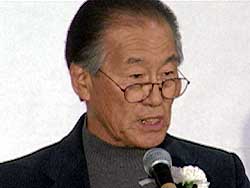
Watch a 70-second QuickTime video clip of Heart Mountain resistance leader Frank Emi's acceptance speech and challenge to the JACL [requires free ]. |

This ceremony is especially meaningful to me as I was one of the
organizers of the Heart Mountain Fair Play Committee (FPC) which legally
challenged the constitutionality of drafting inmates from the
concentration camps and thus raised the ire of the wartime JACL leaders
and bore the brunt of their vicious attacks.
They even went so far as to say that the FPC leaders should be charged
with sedition, a very serious crime, one which even the government did not
invoke.
When the appellate court reversed the convictions of the FPC leaders, the
court in rendering their opinion, said, in part, "But to counsel merely
refusal is not made criminal by the act. One with innocent motives, who
honestly believes a law is unconstitutional and therefore not obligatory,
may well counsel that the law shall not be obeyed; that its command shall
be resisted until a court shall have held it valid, but this is not
knowingly counseling, stealthily and by guile, to evade its command."
In 1947, when President Truman issued a presidential pardon to the draft
resisters, the head of the president's amnesty board, Owen J. Roberts,
former associate justice of the Supreme Court, issued a special report
regarding the Japanese Americans who had been convicted of violation of
the Selective Service Act.
In this report the board commented on the dilemma of the Nisei who
resisted the draft. It said, in part: "Closely analogous to conscientious
objectors, and yet not within the fair interpretation of the phrase, were
a smaller, though not inconsequential number of Americans of Japanese
ancestry, who were removed in the early stages of the war from their homes
in defense coastal areas and placed in war relocation centers. Although we
recognized the urgent necessities of military defense, we fully appreciate
the nature of their feelings and their reactions to orders from local
Selective Service Boards."
The government showed more understanding of the Nisei draft resisters than
some of our wartime JACL leaders.
I have always felt they went overboard with their accomodationist
policies.
In recent months, the Sacramento Nisei VFW Post 8985 and Sus Satow, a
member of the organization, has sent news articles opposing this ceremony
and
enticed other Nisei VFW posts to join in their protest. That is their
prerogative but their articles were replete with misinformation, errors of
facts and outright fabrications.
For example, they keep repeating the same old tale that the resisters
intimidated, harassed and beat up men who volunteered or responded to the
draft. I can assure you that nothing like that took place at Heart
Mountain where the only organized draft resistance took place.
They also continue to accuse the draft resisters of beating JACL leaders
in some camps in 1943. The fallacy of that statement is there was no draft
for internees in operation at that time so there were no draft resisters.
Selective Service applicable to Nisei in camps was not implemented until
January 1944.
These are just a couple of the untrue statements included in their news
articles published in various JA newspapers.
Also, there were some very strange statements made by veterans of Post
8985. For example, in one of their articles, they stated that the Nisei
military played a key role in bringing the civil rights issue to the
forefront. Really! Wasn't it the African Americans that started the civil
rights movement of the sixties.
Here is another one. The Sansei commander of Post 8985 wrote in an article
in
the Pacific Citizen that it was due to the Nisei soldiers that the
Japanese
Americans were released from the internment camps. Apparently he never
heard of the Mitsuye Endo case on the internment which was successfully
argued in the United States Supreme Court and the Court ruled that
internment of U.S. citizens was unconstitutional and ordered that the
internees be released.
These self serving statements, misinformation, deliberate fabrications of
facts and their mindless opposition to this ceremony only tends to
discredit Post 8985 in the eyes of the public. I hope they will use better
judgment in the future.
To give you an idea of how some non-Japanese veterans of World War II
reacted to the internees' draft resistance story, I would like to
briefly cite two incidents.
The first event took place during the redress and reparations movement
when a reporter from the L.A. Times interviewed me about our draft
resistance struggle at Heart Mountain. My story was headlined on the front
page of the Metro Section of the Times and about 8 a.m. on the morning my
story broke, the first call I received was from a gentleman who identified
himself as a retired U.S. Navy veteran. He said that he had fought the
Japanese in the Pacific, fought in the Korean Conflict and had been to
Italy where he had met the 442nd Regimental Combat Team whom he praised
very highly. Well, by this time, I thought the crap was really going to
hit the fan. Then he really surprised me. He congratulated me for fighting
for our rights as American citizens and thanked me for the stand that we
took. He said that he would have done the same thing if he were in our
shoes. After a long conversation about our internment experience and the
ongoing redress movement, he promised to write congress in support of the
redress bill and said he would get some of his Navy buddies to also
support it. He later sent me copies of letters he had sent.
Another interesting event took place at a draft resisters' panel
discussion
in Oakland, hosted by Dr. Clifford Uyeda, former president of national
JACL. During the audience participation period, a Caucasian gentleman
stood up and said he was a World War II veteran. He said he was in Europe
fighting for democracy and when he found out that Japanese Americans were
denied the very democratic principles he was fighting for, this made him
very angry and disappointed. He congratulated us for the stand we took. He
was very emotional and his voice began to shake towards the end of his
statements. The audience broke into a very loud spontaneous applause. It
was very moving.
In closing, I wish to extend my appreciation to the JACL for sponsoring
this ceremony. As a civil rights organization, I believe it is a step in
the right direction.
Having said that, I think it would be entirely appropriate for JACL to go
one step further and hold a similar program directed towards the Japanese
American community for the excesses committed by wartime JACL leaders,
such as acting as informants for the government causing many innocent
people to suffer as recorded in the Lim Report.
I believe such action would finally put to rest JACL's unholy ghosts of
the past and would be a worthy way to start the 21st century.
The United States government apologized for their wartime excesses. Can
JACL do less?
Thank you.
Return to the News index of other related articles.
HOME | DOCUMENTS | STUDY CENTER | NEWS | LINKS | ABOUT US | E-MAIL
Updated: March 16, 2003