
|
PEARL HARBOR: Big, Dumb, Irrelevant By Frank Abe
After all, weve spent the past 60 years distancing ourselves from the Imperial Japanese Navy that attacked the naval base at Pearl Harbor. We spent three years in American concentration camps as retribution for Pearl Harbor, solely because we looked like the enemy. Like it or not, Pearl Harbor defines our lives. But it's impossible to take Disneys PEARL HARBOR seriously as a film, or a threat. It has nothing new to say about the attack, the war, or anything else. It's a ponderous, bloated 3-hour spectacle that exists only to provide video arcade explosions for the boys and a love story for the girls in the movies 12 to 25 year old target audience. It operates on the intellectual and emotional level of another historical disaster movie with a generic title, TITANIC, with two love stories for the price of one in the triangle between two fighter pilots and a nurse. PEARL HARBOR even lifts shots from TITANIC, from the sailors clinging to the deck of the USS Arizona as it slides at right angle into the water to the masses of floating bodies. It recycles the lyrical bi-plane flight from OUT OF AFRICA, and the screaming point of view of the falling A-bomb from DR. STRANGELOVE. Weve seen it all before. PEARL HARBOR strives to be familiar and therefore comforting to the movie audience so they can leave the theater feeling pacified, not agitated. Though the movie vividly recreates the illusion of experiencing the attack, in a computer-enhanced set piece that lasts almost as long as the real event, audiences will not likely be moved to go out and seek revenge. Thats partly because the story doesnt climax with the attack. The utter defeat of Pearl Harbor would end the picture on a downer, so obeying the formula of Hollywood storytelling the filmmakers have to find some way to show America fighting back. They do this by adding a half hour with the two pilots flying together on Jimmy Doolittles "Thirty Seconds Over Tokyo" raid, the suicide mission demanded by President Roosevelt to rally American morale at home.
On the question of espionage, there are two brief bits with a Japanese tourist (Seth Sakai) who takes aerial photographs of the deployment of ships in the harbor, but its implied he is a Japanese national, and there in the press notes he indeed is credited as "Japanese Tourist." There is also a confusing bit with a Japanese American dentist at work in Hawaii (Sung Kang) getting a phone call from Tokyo asking him, "What ships do you see in the harbor?" He replies as best as he can see out his window, then asks, "Say, who is this?" and when he hangs up he says, "Gee that was a strange call." So instead of being a spy for Japan, we see one Hawaiian local who is duped into providing intelligence. What is remarkable about that scene is that we cut to a dark room where a U.S. soldier who is evidently supposed to be a Nisei MIS interpreter is electronically eavesdropping on the call and translating. But all of it passes so quickly none of it really registers. To get more Japanese American characters into the movie, National JACL and the Media Action Network for Asian Americans (MANAA) got the filmmakers to include a Japanese American doctor at Pearl Harbor (Vic Chao) who helps a wounded sailor during the attack but is told, "I don't want a Jap touching me." Activists are proud of getting that moment but I blinked and heard the line but missed his face. PEARL HARBOR is not as bad for Japanese Americans and American history as it could have been, but thats just whats on the screen. Socially, what goes on in the heads of viewers cant be predicted. National JACL has wisely tightened security at its headquarters in San Francisco. Sometime, at some multiplex somewhere, some kid is going to come out of the theater and take delight in calling someone a "J*p" this or "J*p" that. And on June 8th at SAFECO Field the Seattle Mariners are going to distribute 20,000 Kazuhiro Sasaki white hachimaki headbands like those worn by the Japanese fighter pilots, minus the rising sun. At any other time I would be able to relax and enjoy the sight of fans of all races proudly wearing their Ichiro and Sasaki jerseys. Ill wear my headband, but we will see how many other Japanese American fans choose to keep the souvenirs in their pocket. December 7th has traditionally been a day when Japanese Americans went into hiding. Thanks to Disney and Jerry Bruckheimer, we now get to enjoy December 7th all summer long. HOME | DOCUMENTS | STUDY CENTER | NEWS | LINKS | ABOUT US | E-MAIL Updated: May 23, 2001 |
 There are only two questions that Japanese American audiences have
going into a screening of the new Disney movie, PEARL HARBOR: Am I going
to get punched in the face by kids coming out of the theater looking for
revenge? And are Japanese Americans once again going to be blamed for
conspiring in the attack?
There are only two questions that Japanese American audiences have
going into a screening of the new Disney movie, PEARL HARBOR: Am I going
to get punched in the face by kids coming out of the theater looking for
revenge? And are Japanese Americans once again going to be blamed for
conspiring in the attack?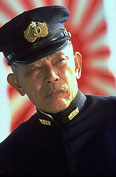 And
mercifully, the film does not demonize the Imperial Japanese admirals and
pilots who lead the attack. We see a lot of the red "Rising Sun"
flag, but no "banzais," robotic emperor worship, or foaming
at the mouth, though we do get the ridiculously contrived shot of innocent
children playing next to a top-level military meeting. In a smart yet
understated performance, Mako must bear the weight as the films
antagonist and he is allowed to portray Admiral Yamamoto as a reasoned,
thoughtful strategist who becomes difficult for the audience to hiss. Two
key lines define his character. When Yamamoto is congratulated for his
brilliant attack plan, he replies, "A truly brilliant man would find
a way not to go to war." Another cast member, Cary-Hiroyuki Tagawa,
reportedly suggested Yamamotos line complaining that the U.S. oil
embargo was pushing Japan into war, a line that takes the edge off the
Japanese motives. The Japanese pilots are never seen by face in the
cockpit; so the attack and the subsequent dogfights have more the quality
of a video game than anything personal or racial.
And
mercifully, the film does not demonize the Imperial Japanese admirals and
pilots who lead the attack. We see a lot of the red "Rising Sun"
flag, but no "banzais," robotic emperor worship, or foaming
at the mouth, though we do get the ridiculously contrived shot of innocent
children playing next to a top-level military meeting. In a smart yet
understated performance, Mako must bear the weight as the films
antagonist and he is allowed to portray Admiral Yamamoto as a reasoned,
thoughtful strategist who becomes difficult for the audience to hiss. Two
key lines define his character. When Yamamoto is congratulated for his
brilliant attack plan, he replies, "A truly brilliant man would find
a way not to go to war." Another cast member, Cary-Hiroyuki Tagawa,
reportedly suggested Yamamotos line complaining that the U.S. oil
embargo was pushing Japan into war, a line that takes the edge off the
Japanese motives. The Japanese pilots are never seen by face in the
cockpit; so the attack and the subsequent dogfights have more the quality
of a video game than anything personal or racial.