|

Bi-District Hosts Panel Discussion on WWII
Resistance
By MARTHA NAKAGAWA
Assistant Editor
Pacific Citizen, July 20, 2001
SEATTLEThe educational forum titled, WWII, JACL, Nikkei Patriotism and
Protest, held at the IDC/PNW bi-district conference July 13-15 got off to a
rough panel start but ended on a positive note.
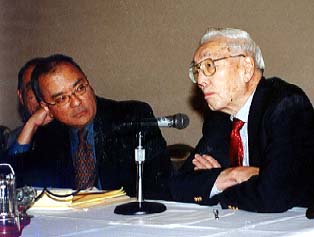
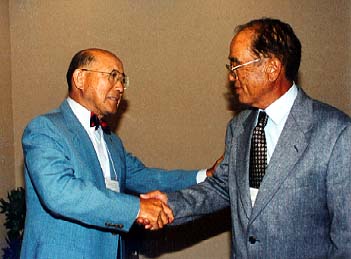
 Panelists included: Frank Abe, award-winning reporter for KIRO Radio and TV
in Seattle, and producer/director of the award-winning documentary
Panelists included: Frank Abe, award-winning reporter for KIRO Radio and TV
in Seattle, and producer/director of the award-winning documentary
Conscience and the Constitution; Bill Hosokawa, former editorial page
editor of the Denver Post and Pacific Citizen columnist; Mits Koshiyama, a
Heart Mountain resister; and Fred Shiosaki, 442nd veteran who survived the
infamous battle to save the Texas Lost Battalion.
National JACL Executive Director John Tateishi opened the session by
reminding the audience that the repercussions still felt in the Japanese
American community today is largely due to the actions of the U.S.
government
during World War II, which forced Japanese Americans to make difficult
decisions under difficult times.
Tateishi noted that during his years of research he found documents dating
back as early as 1938-39 in which the government was making plans to remove
JAs from the West Coast.
Tateishi also made it no secret that he had been critical of JACL in the
past. What changed Tateishis mind was his dealings with the federal
government during the redress campaign and his discussions with the late
Mike
Masaoka, JACLs wartime leader.
In 1979, when I first went to Washington and met with members of Congress
and individuals in the agencies and in the White House, what I realized was
that you cant move a mountain, that the mountain moves you, said Tateishi.
As righteous as our cause was, as much as we could insist on certain
things,
it mattered not at all.
Because of his own difficult dealings with the federal government, Tateishi
said he has come to a better understanding of the extraordinary
circumstances
in 1942 in which JACL counseled cooperation with the government to head off
forced removal and possible outbreaks of violence.
And with close to 60 years of hindsight and in the aftermath of the 1960s
civil rights movement, Tateishi said it would be easy and safe for him and
others from the younger generation to verbally say that they would have
resisted. But in reality, Tateishi said he does not know what his choice
would have been, particularly in light of the fact that during the Vietnam
War, he chose to wear the uniform when he got his draft call.
Panelist Bill Hosokawa, rather than open the panel by answering the question
posed by moderator Washington State Rep. Sharon Tomiko Santos, responded to
Tateishis comments.
He (Tateishi) talked about a government plot to destroy us as a people,
said Hosokawa. I would like to see documentation on that. Apparently John
has a lot of documents to prove that but this is a terrible indictment. If
that is so, we ought to know more about it.
He also questioned the need for JACL to apologize to the resisters. I
respect the decisions of the resisters to follow their conscience, said
Hosokawa. I am also not clear on what they are hoping to get in the way of
an apology. What do we have to apologize for? They did what they thought was
right. The others did what they thought was right. Why is it necessary for
one to apologize to the other?
Hosokawas comments seemed to throw off second speaker Frank Abe, who paused
for a moment before saying that he felt compelled to address some of the
points raised by Hosokawa.
Let me just answer Bills question. I think that its important just to
point out that the resisters never asked for an apology, said Abe. In all
my conversations with Frank Emi, Mits Koshiyama and others, this is nothing
that they wanted. Clearly this is a movement inside JACL to make an
acknowledgement of its own wartime actions.
Abe said this internal movement within JACL crossed generational lines and
includes Nisei such as Paul Tsuneishi to Sansei such as Andy Noguchi.
Hosokawa addressed Abes comments saying this was the first time he had
heard
that the JACLs resolution to apologize to the resisters had come from
within
JACL. During his remarks, Hosokawa repeatedly referred to the resisters as
no nos, a group of camp dissidents completely different from the resisters
of conscience, who had refused to serve in the military until their
constitutional rights were restored and their families released from U.S.
concentration camps.
This is the first time I understood the no no people are not asking for an
apology, said Hosokawa. Apparently the move for an apology came from
within
the JACL, and it is a generational thing.
I think its very important to
make that point because the question that comes to my mind is that if there
is a movement on the part of the no no boys to seek an apology, the question
then becomes: are the rest of us entitled to seek an apology because of the
discomfort that the no no boys created for us by taking the position they
did
during a very sensitive period?
In a friendly back and forth volley between Abe and Hosokawa, Abe addressed
Hosokawas incorrect use of the term no no. The Heart Mountain boys were
either yes yes or no yes on the questionnaire, said Abe.
Heart Mountain resister Mits Koshiyama reiterated Abes point, saying he
answered the so-called loyalty questionnaire with a yes yes and qualified
his answers. He added that most of the resisters he personally knew answered
yes yes.
If we were no no, we would have been put into the Tule Lake camp, said
Koshiyama.
Koshiyama, in sharing about his resistance experience, noted that he and his
older brother had joined the JACL right after the bombing of Pearl Harbor.
And while his brother, a MIS veteran, remained a JACL member until his
death,
Koshiyama said he dropped his membership after JACL opposed their stand
calling for the restoration of their constitutional rights.
Koshiyama also pointed to the scathing editorials that appeared in the P.C.
and the Heart Mountain Sentinel, condemning the actions of the resisters,
and
he felt that JACLs recent move to apologize to the resisters was a step in
the right direction.
JACL called the resisters disloyal and that we should be tried for
sedition, said Koshiyama. Thats a pretty strong charge, and apologizing
for those kinds of actions, I dont believe, is out of line.
But Hosokawa defended the actions of the newspapers. The Heart Mountain
Sentinel, of which I was the editor for a brief period, was very, very
critical of the dissidents, said Hosokawa. There were materials published
in that paper that I would not have allowed to be published had I been
there.
I want to make that point clear, that all of this happened after I left
camp.
But there is an obligation on the part of the press to report what is going
on in an impartial matter. There is also the obligation of the paper to
comment upon the events of the day. And the paper was entirely justified in
criticizing the actions of a small minority, but in moderation.
The only moment of outburst during the question and answer session came from
Jeff Itami, a Salt Lake City chapter member and former Heart Mountain
internee.
Turning to Koshiyama, Itami said, My problem with your position is that I
would like to know why, since JACL has changed with the times and things
have
moved on, why you are still being so bitter against JACL from back then. I
mean the organization youre dealing with and the people who youre dealing
with is a different group, you know, and Id like to see you let go a little
bit and be a little bit more forgiving too. My god, World War II, is long
gone. Get over it buddy.
In response, Koshiyama said: I dont believe Im bitter or anything against
JACL. Like I said, I was a member before. My family were JACL people. But if
JACL is willing to apologize and acknowledge their mistakes, I dont see
anything wrong with that. Why did we ask the United States government to
acknowledge their mistakes? Why dont we just forget about that and forget
about redress and go on?
 Fourth panelist, Fred Shiosaki, was a 442nd veteran who had lived in a
predominately Caucasian neighborhood outside the Western Defense zone and
was
thus never incarcerated in a U.S. concentration camp.
The young men who came out of the camps, I really admire them, said
Shiosaki. I really couldnt understand them. I couldnt understand why
theyd volunteer. Id heard stories about how they were verbally abused when
they volunteered, and how some of their families living quarters were
vandalized. And I asked myself then under those circumstances, would I have
volunteered? It was a question, I did not have to answer.
But at the same time, Shiosaki commended the resisters. For those resisters
of conscience, I have great admiration for them, said Shiosaki. That took
more guts than to volunteer.
Koshiyama noted that one of the high points in his life was when several
Nisei veterans organizations passed resolutions of reconciliation with the
resisters.
I think one of the happiest moments of my
life was when a lot of these
veterans extended their hands of friendship and said they understood what we
stood for, said Koshiyama. We were not pro-Japan or anything like that.
All
we wanted was the return of our constitutional rights and the release of our
parents from the concentration camps before induction. Thats all we asked
for, and Im sure thats not asking for too much.
©
2001 Pacific Citizen, reprinted
by permission.
HOME |
DOCUMENTS | STUDY CENTER |
NEWS | LINKS
| ABOUT US | E-MAIL
Updated: July 23, 2001 |